

GGU-CANTILEVER
 GGU-CANTILEVER
Analysis and design of cantilever walls
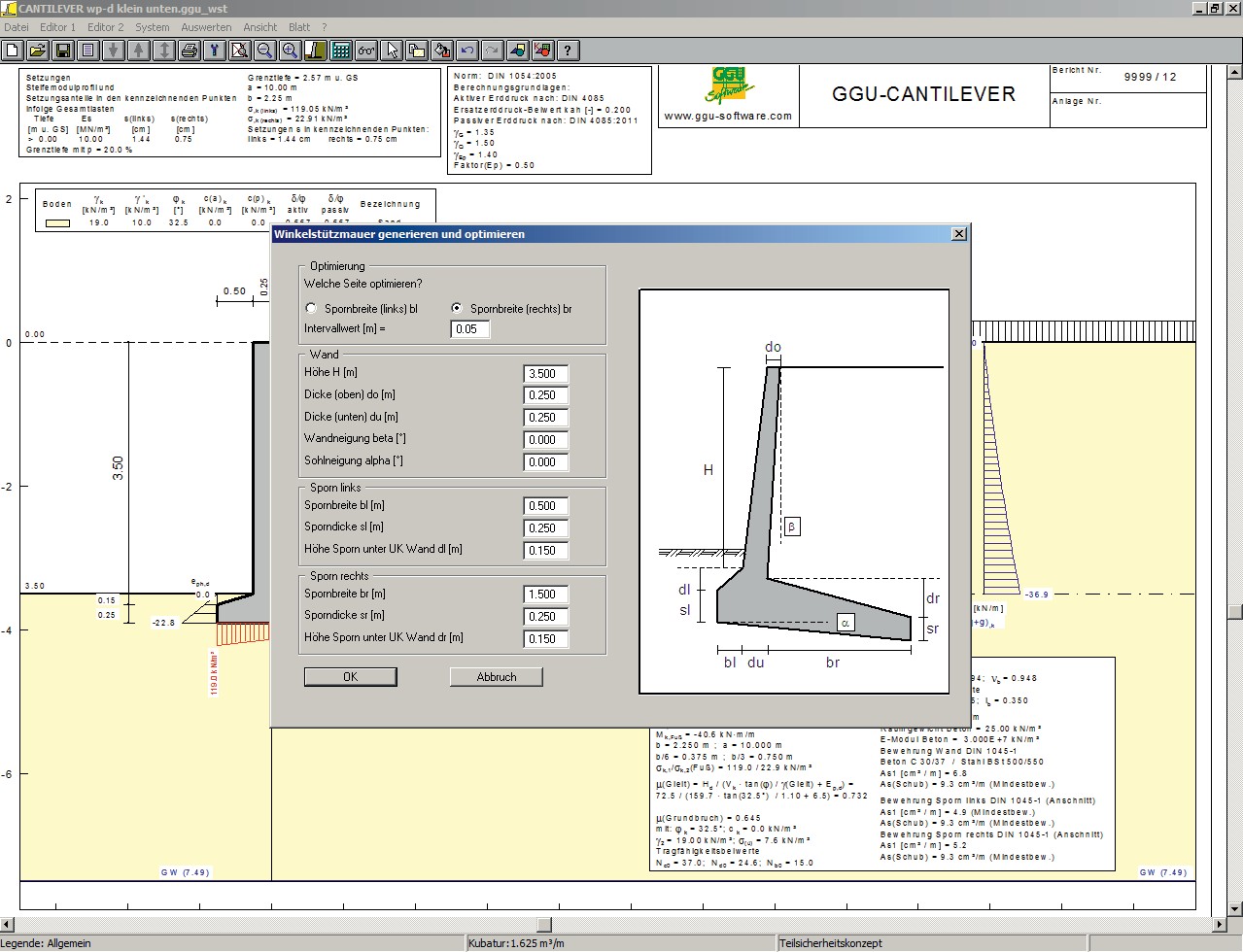
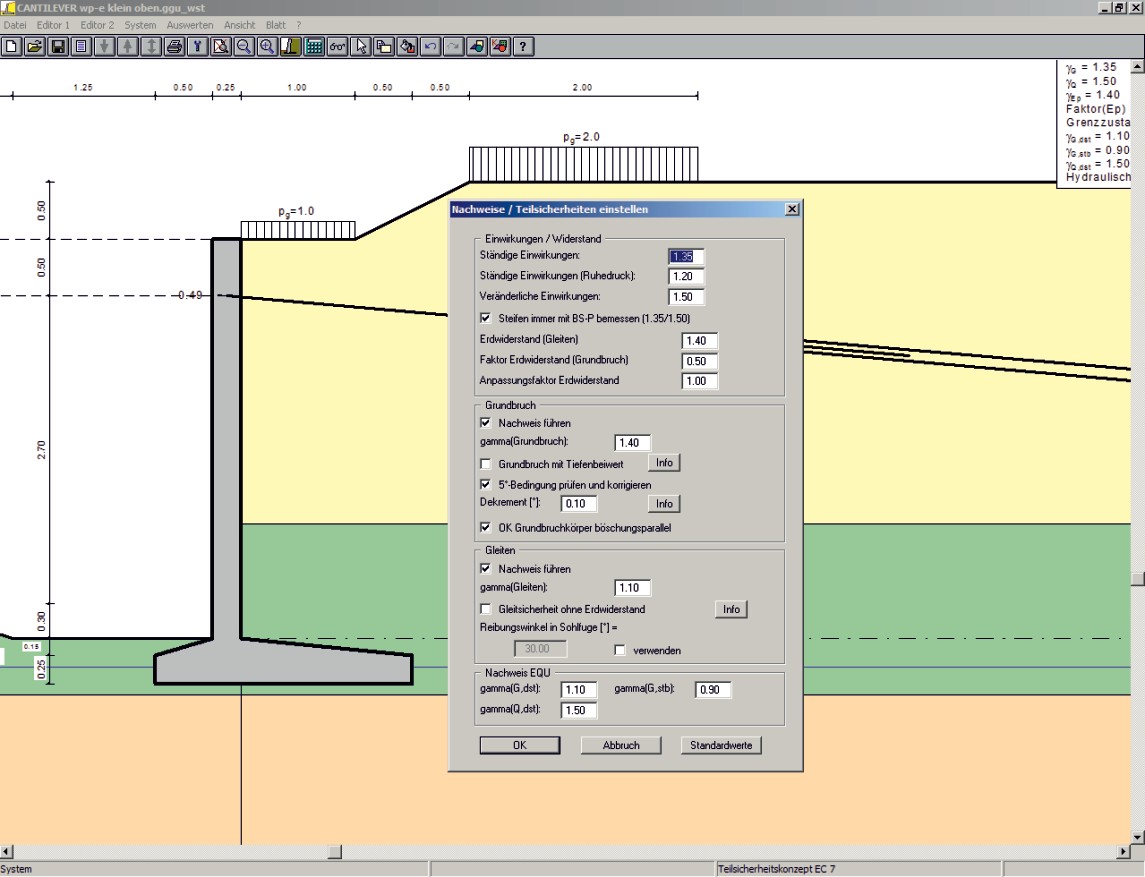

Capabilities:
- Choice of analysis using either partial safety factors according to EC 7, DIN 1054:2005, Austrian Standard ÖNORM EN 1997-1 or global safety factor (DIN 1054 old)
- System input using absolute heights
- Analysis using active earth pressure, at-rest earth pressure and increased active earth pressure
- Active earth pressure coefficients according to DIN 4085, after Culmann or user-defined values
- Redistribution of the active earth pressure definable
- Consideration of earthquake according to EC 8 or EAU 1990, additionally consideration of a horizontal load from a rigid structure or from dead weight of the wall
- Passive earth pressure coefficients to DIN 4085:2011, Streck, Caquot/Kerisel, Culmann or user-defined values
- Soil properties can be selected from an expandable database of common soils
- Berms on the active and the passive side
- Bounded and double-bounded surcharges on active and passive side
- Loads with limited plan dimensions according to “Spundwand-Handbuch”, fig. 4.20, or DIN 4085:2017-08
- Consideration of displacement and action boundary conditions, anchors, struts, etc.
- Consideration of pre-tension and pre-deformations
- Verification of highly eccentric loads and limitation of misalignment
- Verification of the bearing capacity resistance (including the 5° condition to DIN 4017) and of the sliding resistance
- Settlement analysis according to DIN 4019
- Limiting depth analysis using p % of overburden stress, a multiple of footing width b' or a fixed value
- Verification of the deep-seated stability with optimization of anchor lengths
- Verification for heave of anchor soil
- Horizontal water pressure approach: classical or with flow conduits according to the potential theory. With it: consideration of hydraulic gradients on the active and the passive side
- Verification of hydraulic heave safety and buoyancy safety
- Reinforced concrete design and crack width verification to EC 2 for circular and rectangular cross-sections
- Print out table for the reinforcement distribution
- Anchor steel design
- Interface to the computer program GGU-STABILITY for the verification of the global stability
- Choice of visualization of earth pressure on the equivalent wall, water pressure, moments, shear force, normal force, displacement, soil pressure, settlements and bending line
- Selected standard, program name and version can be included in the General legend
- User-designed output sheet
- Print or copy screen sections, e.g. for transfer to a word processor
- Integrated Mini-CAD system for additional annotation of graphics
Current updates & changes
6.5 (21.05.2026)
- Bug: Incorrect base pressure with inclined spur top edge with anchor or brace
6.4 (20.05.2026)
- Feature: Update WPViewPDF-DLL (wPDFViewMKIMG04.dll) from v4.3 to v6.x
6.3 (06.05.2026)
- Bug: eav acts in the wrong direction for the spur design moment
- Bug: Signs of the spur moments do not match the user manual
6.2 (27.04.2026)
- Bug: Internal forces at the heel connection are exaggerated when 'No traffic on heel' is active
6.1 (22.04.2026)
- Bug: Base water pressure missing in spur internal force calculation
- Bug: Block load lever arm incorrect for inclined wall at spur
Show all entries
Online-Shop:
All prices incl. VAT
Information about our licenses
Simple and secure processing!
During the further order process you switch to the store system of our technology partners "WIBU Systems" and "cleverbridge". You can find out more about these companies under the following links.
 |  |
Additional information:
System preferences
GGU-Software runs on PCs with the following specifications:
- Pentium III or higher processor
- Microsoft Windows® (SAC), 11, Server 2016, 2019 and 2022 compatible
- 500 MB free hard disk space
- DVD-ROM drive or internet connection (for installation)
- USB Interface 2.0 or higher (for licence CmStick dongle)
- CmActLicences NOT on virtual maschines
1x Floating Network License
1.472,63 €
incl. VAT
365 days rent
- Free support
- Always current versions
- CmCloudContainer
- Supports virtual PCs
- Automatic license distribution
- Access via network/VPN
- Ends automatically
- Access for teams
1x Non-Network License
981,75 €
incl. VAT
365 days subscription
- Free support
- Always current versions
- License binding to PC
- One program user
- Automatic renewal
- Annually cancelable
1x Floating Network License
264,00 €
incl. VAT
10h PayPerUse
- All GGU applications included
- Free support
- Always current versions
- License binding to PC, CmCloudContainer or Dongle (CmStick with serial numbers starting with 3-344xxxx)
- Access via network/VPN
- Usage time by the minute
- All programs included
- Ends automatically
- Ideal for home office and license usage spikes